

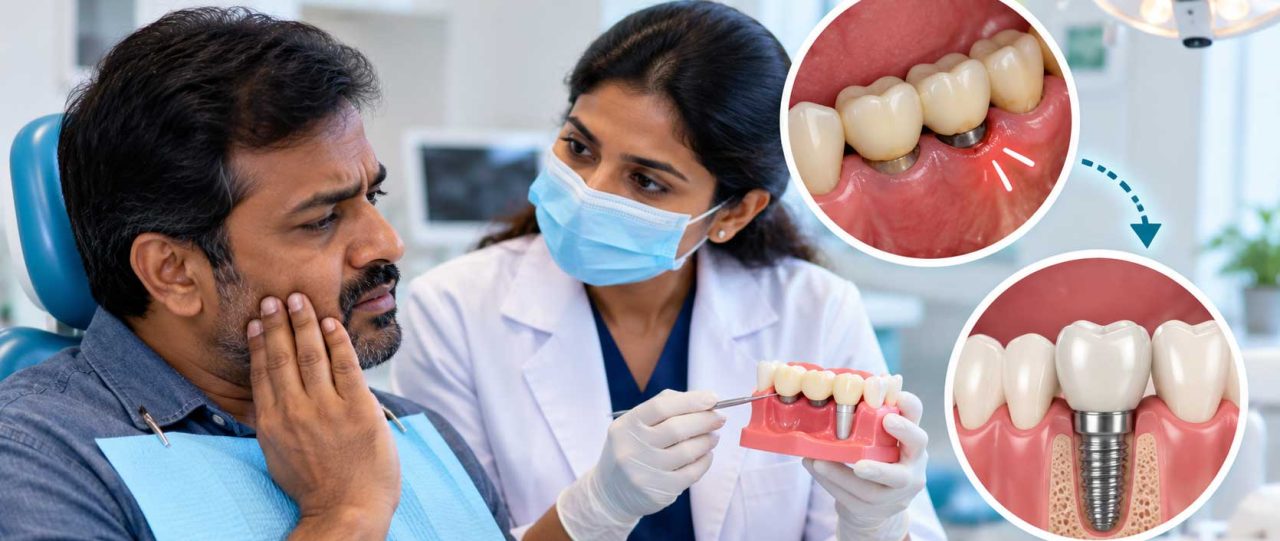
Dental bridges are a common way to replace missing teeth. With proper planning, placement and maintenance, a bridge can function effectively for years. However, problems can develop when a bridge is not properly planned, fitted or placed, particularly when the supporting teeth, gums and bite are not thoroughly evaluated.
If an existing bridge is repeatedly causing discomfort or functional problems, it may be time to have it reassessed. In some cases, dental implants may provide an alternative way to replace the missing tooth without relying on neighbouring teeth for support.
Signs Your Dental Bridge May Need Replacement
1. Your Bridge Feels Loose or Unstable
A dental bridge should remain stable during eating and speaking. If it starts moving, rocking or feeling loose, there may be an issue with the bridge, cement or supporting teeth.
A loose bridge should be examined promptly rather than continuing to use it and potentially causing further damage.
2. You Have Problems with the Supporting Teeth
Traditional bridges depend on neighbouring teeth for support. If these teeth develop decay, cracks, root problems or gum disease, the stability of the bridge can be affected.
When the supporting teeth are severely compromised, replacing the bridge with another conventional bridge may not always be the most suitable option. Dental implants may be considered as an alternative foundation for tooth replacement.
3. Food Frequently Gets Trapped Around the Bridge
Repeated food trapping underneath or around a bridge can make cleaning difficult and may contribute to gum irritation or decay.
It can also be a sign that the restoration does not have an ideal fit or that the surrounding tissues require attention.
4. Your Gums Are Frequently Swollen or Bleeding
Persistent redness, swelling or bleeding around a dental bridge should not be ignored.
Poor fitting, plaque accumulation, inadequate cleaning or problems with the supporting teeth can contribute to gum inflammation. An examination can determine whether the bridge can be maintained or requires replacement.
5. Your Bite Has Changed
You may notice that your teeth no longer meet comfortably or that certain teeth experience more pressure while chewing.
Changes in the bite can occur as the teeth, restoration and supporting structures change over time. Your dentist can assess whether the bridge needs adjustment, replacement or a different treatment approach.
6. The Bridge Is Showing Signs of Wear or Damage
Dental bridges are not designed to last indefinitely. Chipping, cracking, worn surfaces, damaged margins or changes in fit may indicate that a bridge needs to be evaluated.
An old bridge does not automatically need to be replaced with an implant. However, if replacement is required, implants may be an option depending on the condition of the surrounding teeth and bone.
Why Proper Bridge Treatment Matters
A dental bridge is not simply a replacement tooth. It needs to work in harmony with the supporting teeth, gums and bite.
When bridges are poorly planned, improperly fitted or placed without adequate assessment, problems may develop over time. Patients may experience looseness, food trapping, gum irritation, recurrent decay around supporting teeth or discomfort while chewing.
This is why dental bridges should be planned and placed at a professional dental centre with appropriate diagnostic evaluation and restorative expertise. Accurate impressions or digital scans, careful bite assessment, precise fabrication and regular follow-up all contribute to the long-term performance of a bridge.
If an existing bridge has repeatedly developed problems, the underlying cause should be identified rather than simply replacing the restoration without reassessing the overall treatment plan.
When Can Dental Implants Be Considered?
Dental implants may be considered when:
- Supporting teeth are severely damaged or cannot be predictably restored
- A conventional bridge has repeatedly failed
- You want to replace a missing tooth without depending on adjacent teeth
- The surrounding bone and gums are suitable for implant treatment
- Multiple missing teeth require a more comprehensive rehabilitation
An implant replaces the missing tooth root and can support a crown, bridge or other implant-supported restoration.
However, implants are not automatically the right solution for every failed bridge. A detailed assessment is necessary to determine the most appropriate option.
Dental Bridge vs Dental Implant
| Dental Bridge | Dental Implant |
| Usually supported by neighbouring teeth | Supported by an implant placed in the jawbone |
| Does not require implant surgery | Requires implant placement and healing |
| Can replace one or more missing teeth | Can support an individual crown or larger restoration |
| Treatment can often be completed without implant healing | Treatment timeline depends on bone and tissue healing |
| Requires suitable supporting teeth | Requires adequate bone and healthy surrounding tissues |
The choice depends on the individual’s oral health, bone condition, bite, number of missing teeth and long-term treatment goals.
How Digital Dentistry Supports Implant Treatment
Modern digital dentistry allows implant treatment to be planned with greater precision.
At Maeoris Dental Clinic, digital workflows can incorporate CBCT imaging, intraoral scanning, CAD-CAM prosthetic planning, dynamic navigation and implant photogrammetry.
For complex full-arch cases, combining accurate implant positioning with precise prosthetic planning is particularly important. Maeoris has also integrated X-Guide Next navigation with implant photogrammetry, bringing surgical navigation and prosthetic precision together within an advanced digital workflow.
When Should You Have Your Dental Bridge Checked?
Do not wait until your bridge completely fails. Schedule a dental evaluation if you notice:
- A loose or moving bridge
- Pain while chewing
- Persistent gum swelling or bleeding
- Frequent food trapping
- Bad taste or odour around the bridge
- Cracks or visible damage
- Changes in your bite
- Decay or problems with supporting teeth
- Difficulty cleaning around the restoration
An examination can determine whether the bridge can be repaired or maintained, whether it needs conventional replacement, or whether an implant-supported restoration should be considered.
Replacing a Dental Bridge: Look Beyond the Restoration
An old or problematic bridge does not necessarily mean you need dental implants. The first step is understanding why the bridge is failing and assessing the health of the supporting teeth, gums and bone.
If the existing bridge is no longer suitable, dental implants can provide an alternative foundation for replacing missing teeth in appropriately selected patients.
Choosing a centre with expertise in implant dentistry, restorative treatment and digital treatment planning can help ensure that the replacement is planned around both function and long-term oral health.
Looking for the Best Dental Clinic in Madurai or Dindigul?
Maeoris Dental combines extensive experience in implant dentistry with advanced digital planning and prosthetic workflows.
If you have an old, loose or uncomfortable dental bridge and are considering dental implants in Madurai or Dindigul, a professional assessment can help determine whether your existing bridge can be retained, replaced or transitioned to an implant-supported solution.
Frequently Asked Questions
How do I know if my dental bridge needs replacement?
Looseness, pain, recurrent gum problems, food trapping, visible damage, changes in fit or problems with the supporting teeth are reasons to have your bridge evaluated.
Can a poorly fitted dental bridge cause problems?
Yes. An improperly planned or fitted bridge can make cleaning difficult and may contribute to food trapping, gum irritation, discomfort or problems affecting the supporting teeth.
Can my dental bridge be replaced with an implant?
In suitable cases, yes. The dentist will first assess the supporting teeth, bone, gums and bite before determining whether an implant-supported restoration is appropriate.
Is a dental implant better than a bridge?
Both can be effective options. The appropriate treatment depends on the condition of the neighbouring teeth, bone availability, gum health, number of missing teeth and individual treatment requirements.
Can an old bridge be replaced with an implant without removing the supporting teeth?
It depends on the condition of the existing bridge and supporting teeth. A detailed clinical and radiographic assessment is required before deciding on the treatment approach.