
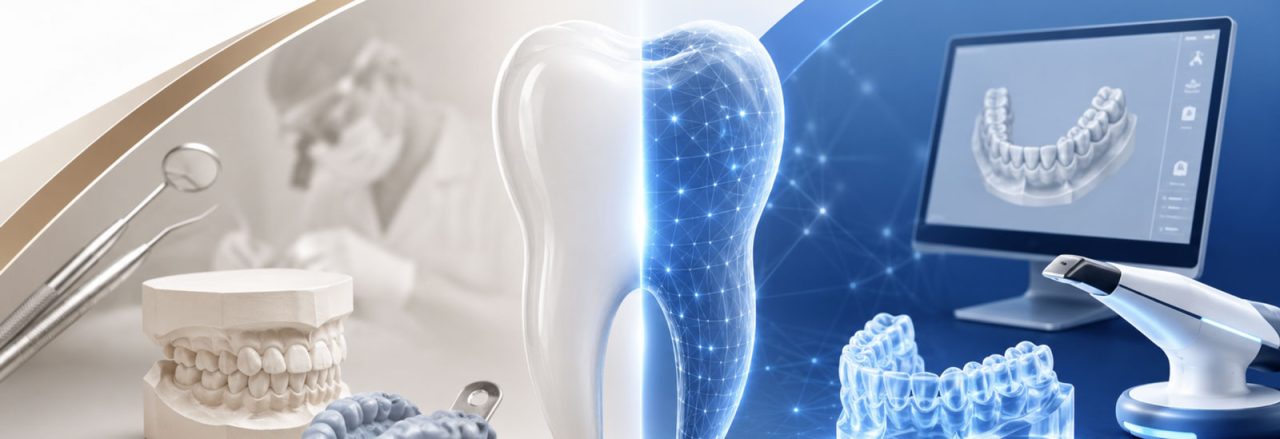
Dentistry has changed significantly over the years. While traditional dental techniques continue to play an important role in patient care, advances in technology have introduced digital dentistry, making diagnosis, treatment planning and restoration more precise and efficient.
From digital impressions and 3D imaging to CAD/CAM restorations and computer-guided implant procedures, digital dentistry workflows are changing how many dental treatments are planned and delivered.
But what exactly is the difference between traditional dentistry and digital dentistry? And does digital always mean better when it comes to dental care?
Let’s understand.
What Is Traditional Dentistry?
Traditional dentistry relies on established clinical techniques and physical methods for diagnosis, impressions, treatment planning and fabrication of dental restorations.
Some commonly used conventional methods include:
- Physical dental impressions using impression materials
- Conventional X-rays
- Physical plaster or stone dental models
- Manual treatment planning
- Laboratory-based fabrication of crowns, bridges and dentures
- Conventional surgical planning
These methods have been successfully used for decades and remain appropriate for many dental procedures. The choice between traditional and digital techniques ultimately depends on the patient’s condition and the dentist’s clinical judgement.
What Is Digital Dentistry?
Digital dentistry uses advanced imaging, scanning, computer software and computer-controlled manufacturing to support different stages of dental treatment.
Depending on the treatment, digital dentistry may involve:
- Intraoral scanners
- Digital X-rays
- CBCT 3D imaging
- CAD/CAM technology
- Digital smile planning
- Computer-guided implant planning
- 3D printing
- Digital models and virtual treatment simulations
Digital dentistry is not a single treatment or procedure. It is a broader approach that can be integrated into diagnosis, treatment planning, restorative dentistry, orthodontics and implant dentistry. If you have visited the top dental clinic in Madurai and Dindigul, Maeoris Dental Clinic, you would have come across these advanced treatments.
Traditional Dentistry vs Digital Dentistry: Key Differences
| Traditional Dentistry | Digital Dentistry |
| Physical impressions | Digital impressions using intraoral scanners |
| Conventional X-rays and 2D imaging | Digital imaging and 3D CBCT when indicated |
| Physical dental models | Virtual 3D dental models |
| Manual or conventional planning | Computer-assisted treatment planning |
| Laboratory fabrication | CAD/CAM-assisted design and manufacturing |
| Multiple manual steps | More integrated digital workflows |
| Physical records and models | Digitally stored patient records and scans |
| Conventional surgical planning | Computer-guided or dynamic navigation options for selected implant procedures |
1. Dental Impressions: Putty vs Digital Scanning
One of the most noticeable differences for patients is how dental impressions are taken.
Traditional impressions involve placing impression material inside a tray and asking the patient to bite down while the material sets.
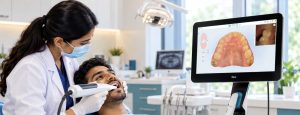
Digital dentistry can use an intraoral scanner to capture a three-dimensional digital representation of the teeth and surrounding structures.
For many patients, digital scanning can be more comfortable and can allow the dentist to view the scan immediately. Digital impressions can also integrate directly with CAD/CAM workflows for designing restorations.
However, digital scanning is not automatically the best option for every clinical situation. The type of restoration, anatomy and treatment requirements influence which impression technique is appropriate.
2. 2D Imaging vs 3D Imaging
Traditional dental diagnosis often relies on conventional two-dimensional radiographs.
Digital dentistry can incorporate CBCT (Cone Beam Computed Tomography), which creates three-dimensional images of dental and maxillofacial structures.
This can be particularly valuable when detailed anatomical information is required, such as for:
- Implant planning
- Assessment of jawbone anatomy
- Locating important anatomical structures
- Complex oral surgery
- Evaluation of impacted teeth
CBCT provides information that may not be visible on conventional 2D radiographs. However, it should be prescribed when clinically justified because it involves radiation exposure.
3. Manual Planning vs Digital Treatment Planning
In a traditional workflow, the dentist may rely primarily on physical models, radiographs and clinical examination to plan treatment.
With digital dentistry, information from different sources can be combined to create a more comprehensive digital representation of the patient’s anatomy.
For example, CBCT data, intraoral scans and facial scans can be integrated in appropriate cases to assist treatment planning.
This can be especially useful for complex treatments such as full-mouth rehabilitation and implant dentistry, where careful planning is essential.
4. Conventional Restorations vs CAD/CAM Dentistry
Traditionally, crowns, bridges and other restorations are designed and fabricated through conventional laboratory processes.
Digital workflows can use CAD/CAM (Computer-Aided Design and Computer-Aided Manufacturing) technology.
The digital workflow may involve:
Digital scan → Computer-aided design → Milling/3D manufacturing → Finishing → Delivery
This can reduce some manual steps and allow dental teams and laboratories to communicate using digital files.
In appropriately selected cases, CAD/CAM workflows can also support faster fabrication and, with suitable chairside systems, same-day restorative treatment.
5. Conventional Implant Planning vs Digital Implant Dentistry
Implant dentistry is one area where digital technology can make a significant difference in treatment planning.
A digital implant workflow may combine:
- CBCT imaging
- Intraoral scanning
- Digital treatment planning
- Surgical guides
- Computer-guided implant placement
- Dynamic navigation
- Digital implant prosthetics
These technologies can help the dentist visualise the planned implant position before surgery and coordinate the surgical and restorative aspects of treatment.
At Maeoris Dental Clinic, digital implant dentistry has been developed progressively over the years. The clinic’s digital workflow includes technologies such as CBCT, facial scanning, intraoral scanning, CAD/CAM prosthetic systems, in-house milling, dynamic navigation and implant photogrammetry.
This evolution has allowed the practice to integrate digital planning, implant surgery and prosthetic fabrication into increasingly connected workflows.
6. Patient Experience
Digital dentistry can also change the patient’s experience.
Digital scans may eliminate the need for conventional impression material in appropriate cases, which can be particularly useful for patients who experience discomfort or gagging during conventional impressions.
Digital systems can also allow dentists to display enlarged images, scans and treatment simulations, helping patients understand their dental condition and proposed treatment more easily.
Is Digital Dentistry More Accurate?
This is one of the most common questions patients ask.
The answer is: it depends on the procedure and how the technology is used.
Digital workflows can improve consistency, reduce certain manual errors and provide detailed digital information. Research has found that digital impressions can provide accuracy comparable to conventional impressions for several applications, while also offering advantages in patient comfort and workflow efficiency.
However, technology does not replace the dentist’s clinical expertise.
A highly advanced scanner or imaging system is only one part of successful treatment. Accurate diagnosis, appropriate treatment planning, clinical experience and proper execution remain essential.
Does Digital Dentistry Replace Traditional Dentistry?
No.
Digital dentistry is not about completely eliminating traditional dental techniques.
Instead, modern dental practices can combine conventional clinical knowledge with digital technologies depending on what is most appropriate for each patient.
Some cases may benefit greatly from a completely digital workflow, while others may still require conventional techniques or a combination of both.
The goal is not simply to use more technology. The goal is to use the right technology for the right patient and the right treatment.
Why Choose a Digitally Equipped Maeoris Dental Clinic?
When considering advanced dental treatment, patients can ask their dentist:
- What imaging is required for my treatment?
- Can digital scanning be used instead of conventional impressions?
- How will my treatment be planned?
- Is CAD/CAM technology available for my restoration?
- Can my implant treatment be digitally planned?
- How will the surgical and prosthetic stages be coordinated?
A digitally integrated workflow can be particularly valuable for complex procedures where accurate planning and coordination between different treatment stages are important.
Traditional vs Digital Dentistry: Which Is Better?
There is no universal winner.
Traditional dentistry remains reliable, clinically established and appropriate for many situations.
Digital dentistry adds technologies that can improve visualisation, planning, communication, workflow efficiency and patient comfort in appropriately selected cases.
The most important factor is not whether a clinic uses traditional or digital dentistry alone. It is whether the dentist can combine clinical expertise with appropriate technology to provide safe, predictable and personalised treatment.
Experience Meets Technology at Maeoris Dental
At Maeoris Dental, technology has been integrated into clinical practice progressively over the years, particularly in implant dentistry and complex rehabilitation.
From CBCT and digital scanning to CAD/CAM prosthetics, dynamic navigation and implant photogrammetry, the focus is on creating a connected digital workflow that supports accurate planning and high-quality treatment.
If you are looking for a top dental clinic in Madurai or a top dental clinic in Dindigul for advanced dental, restorative or implant treatment, a consultation can help determine whether a digital workflow is suitable for your specific needs.
Frequently Asked Questions
1. What is the main difference between traditional and digital dentistry?
Traditional dentistry relies more on physical impressions, conventional imaging, physical models and manual laboratory processes. Digital dentistry uses technologies such as intraoral scanners, 3D imaging, CAD/CAM and digital treatment-planning software.
2. Are digital dental impressions better than traditional impressions?
Digital impressions can be more comfortable and efficient for many patients and treatments. However, their suitability depends on the specific clinical situation.
3. Is digital dentistry more expensive?
The cost depends on the treatment, technology required and complexity of the case. Digital dentistry does not necessarily mean that every treatment will cost more.
4. Is digital dentistry useful for dental implants?
Yes. Digital technologies such as CBCT, intraoral scanning, digital planning, surgical guides and navigation can support implant treatment planning and execution in appropriately selected cases.
5. Can digital dentistry provide same-day crowns?
In selected cases, chairside CAD/CAM systems can allow a restoration to be designed, milled and completed during the same visit. Whether same-day treatment is possible depends on the tooth, restoration and patient’s clinical requirements.
6. Does digital dentistry replace the dentist?
No. Digital technology supports diagnosis, planning and treatment, but clinical examination, professional judgement and treatment execution remain central to patient care.
7. Which is the best dental clinic in Madurai?
If you are looking for a dental clinic with years of experience and modern technology, Maeoris Dental Clinic is the best dental clinic option in Madurai.
Final Takeaway
The difference between traditional and digital dentistry is not simply about replacing old equipment with new technology. It is about creating a more connected approach to diagnosis, planning and treatment.
When advanced digital tools are combined with sound clinical expertise, they can help make complex dental procedures more planned, efficient and patient-friendly.
Maeoris Dental Clinic brings together clinical experience and advanced digital dentistry to deliver modern dental care in Madurai and Dindigul. To know more, book your appointment today.